

How Does AEO Work? A Guide to Answer Engine Optimization
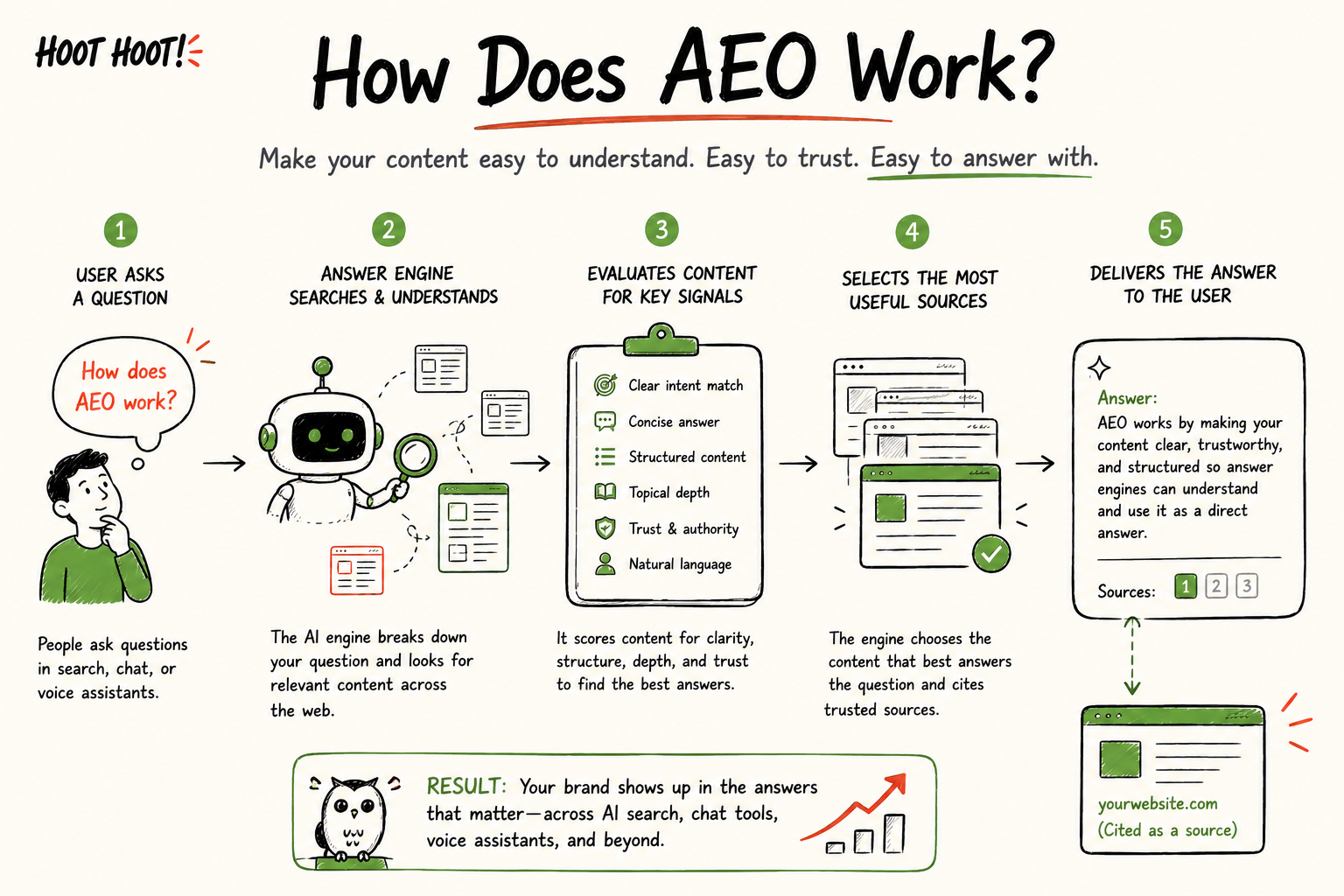

Answer Engine Optimization, or AEO, helps your content become the direct answer people see in AI search tools, voice assistants, featured snippets, and conversational search experiences. Instead of optimizing only for rankings and clicks, AEO focuses on making your information clear, trustworthy, structured, and easy for answer engines to extract. This guide explains how AEO works, why it matters in 2026, and how to build practical content that earns visibility when users ask specific questions.
How does AEO work?
AEO works by helping search and AI systems understand your content well enough to use it as a direct answer. These systems look for pages that clearly answer a question, show topical authority, use logical structure, and provide signals of trust such as accurate details, consistent terminology, and relevant context.
Traditional SEO often asks, “How do we rank this page?” AEO adds another layer: “How do we make this page the clearest answer?” That means your content should define the topic, answer the main question early, support the answer with useful detail, and organize information in a way machines and humans can scan quickly.
If someone searches “How Does AEO Work? A Guide to Answer Engine Optimization,” they are not looking for vague marketing language. They want a clear explanation, practical steps, and examples they can apply to their own website.
AEO and SEO work together
AEO is not a replacement for SEO. It is an evolution of SEO shaped by how people search now: with longer questions, voice queries, AI-generated summaries, and comparison-based prompts. Good SEO still matters because answer engines need crawlable, relevant, well-optimized content to evaluate.
The difference is emphasis. SEO helps your page become discoverable. AEO helps your page become usable as an answer. When both work together, your content can perform better across classic search results, AI overviews, zero-click answers, and conversational search tools.
For brands planning around aeo answer engine optimization 2026, this combined approach is especially important. Search visibility is no longer only about being listed; it is about being selected, summarized, cited, or recommended in the moment a user needs help.
The core signals answer engines look for
Answer engines need confidence. They are more likely to surface content that is direct, complete, and easy to verify.
While every platform works differently, strong AEO content usually shares several qualities:
- Clear intent match: The page answers the question the searcher actually asked, not just a loosely related topic.
- Concise opening answer: The main answer appears near the top before deeper explanation begins.
- Structured formatting: Headings, lists, definitions, and short paragraphs help systems identify useful passages.
- Topical depth: The page covers related subtopics so the answer feels complete, not thin.
- Trust signals: Accurate language, author or business context, fresh information, and consistent claims support credibility.
- Natural wording: Content reflects how real people ask questions, including conversational phrases and long-tail searches.
These signals also improve the reader experience. A visitor should be able to land on the page, understand the answer quickly, and keep reading for practical next steps.
What makes AEO content creation different?
AEO content creation is different because it starts with questions and outcomes, not just keywords. Instead of building a page around one broad phrase, you map the exact questions your audience asks before they buy, compare, troubleshoot, or learn.
A strong AEO page usually includes a direct answer, a deeper explanation, examples, and related questions answered inside the natural flow of the article. The goal is not to stuff every possible query onto the page. The goal is to become the most helpful source for a defined topic.
For example, a page about ecommerce product visibility might address how AI search understands product data, why collection pages need clear descriptions, and how FAQs can support purchase decisions. That is where shopify answer engine optimization aeo best practices become useful: Shopify stores need clean product titles, descriptive copy, structured product information, and helpful category content that answers buyer questions before checkout.
Practical AEO strategies for stronger visibility
The best AEO strategies are simple to understand but require consistent execution. Start with the questions your audience already asks, then build pages that answer those questions better than generic search results.
Use this checklist when creating or improving content:
- Identify the main question. Choose one primary question the page should answer clearly.
- Answer it early. Place a direct, self-contained answer in the introduction or first major section.
- Use descriptive headings. Headings should tell readers what each section explains, not tease or hide the point.
- Add supporting context. Explain why the answer matters, when it applies, and what the reader should do next.
- Include structured information. Use bullets, steps, short definitions, and examples where they make the content easier to extract.
- Strengthen credibility. Avoid inflated claims. Be specific when you have facts and stay general when you do not.
- Update regularly. AEO is sensitive to usefulness. Outdated or incomplete pages can lose relevance as search behavior changes.
These answer engine optimization aeo best practices work across many industries because they align with how both readers and machines process information.
How should businesses approach AEO in 2026?
Businesses should approach AEO in 2026 as a content quality system, not a one-time technical task. The strongest answer engine optimization in 2026 will connect keyword research, customer questions, structured content, technical SEO, and brand authority into one workflow.
Start by auditing your existing pages. Look for content that ranks but does not answer questions quickly, product pages that lack helpful detail, and blog posts that explain topics without a clear takeaway. Then improve the pages with stronger introductions, better headings, concise definitions, and practical examples.
Next, build topic clusters. One page might explain the broad concept, while supporting pages answer specific questions about pricing, setup, comparisons, troubleshooting, or use cases. This gives answer engines more context about your expertise and gives readers a better path through your site.
Finally, remember that AEO is not only about AI search. It supports voice search, featured snippets, local discovery, ecommerce browsing, and sales enablement. When your content answers real questions clearly, it becomes more useful everywhere.
Common mistakes that weaken AEO
Many websites miss AEO opportunities because their content is written for internal approval rather than user clarity. A page may sound polished but still fail to give a direct answer.
Avoid these common issues:
- Burying the answer: If readers must scroll through long introductions before learning the point, answer engines may struggle too.
- Writing around the topic: Broad commentary is less useful than a focused answer with practical detail.
- Overusing keywords: Keywords help, but repeated phrases can make content feel unnatural and less trustworthy.
- Ignoring page structure: Dense paragraphs, vague headings, and missing lists make extraction harder.
- Making unsupported claims: If you cannot prove a number, ranking, award, or comparison, do not invent it.
AEO rewards clarity. The easier your page is to understand, the more likely it is to serve both people and search systems well.
The main takeaway
AEO helps your content become the answer, not just another search result. By combining clear writing, strong structure, user-focused questions, and practical depth, you make your website easier for answer engines to understand and easier for customers to trust.
If you want support building a practical AEO strategy for your website, HootHoot can help. Contact HootHoot to start a conversation about improving your visibility in answer-driven search.
About the Author
Jaymin Shah is the co-founder of HootHoot, an Answer Engine Optimization (AEO) agency helping brands improve their visibility across Ai-powered search and answer engines. He has 10+ years experience specializing in SEO, AEO, and content strategy with a focus on understanding how brands can earn greater visibility and citations as search shifts from traditional results to AI-generated answers.