

AEO vs. SEO: Understand Key Differences
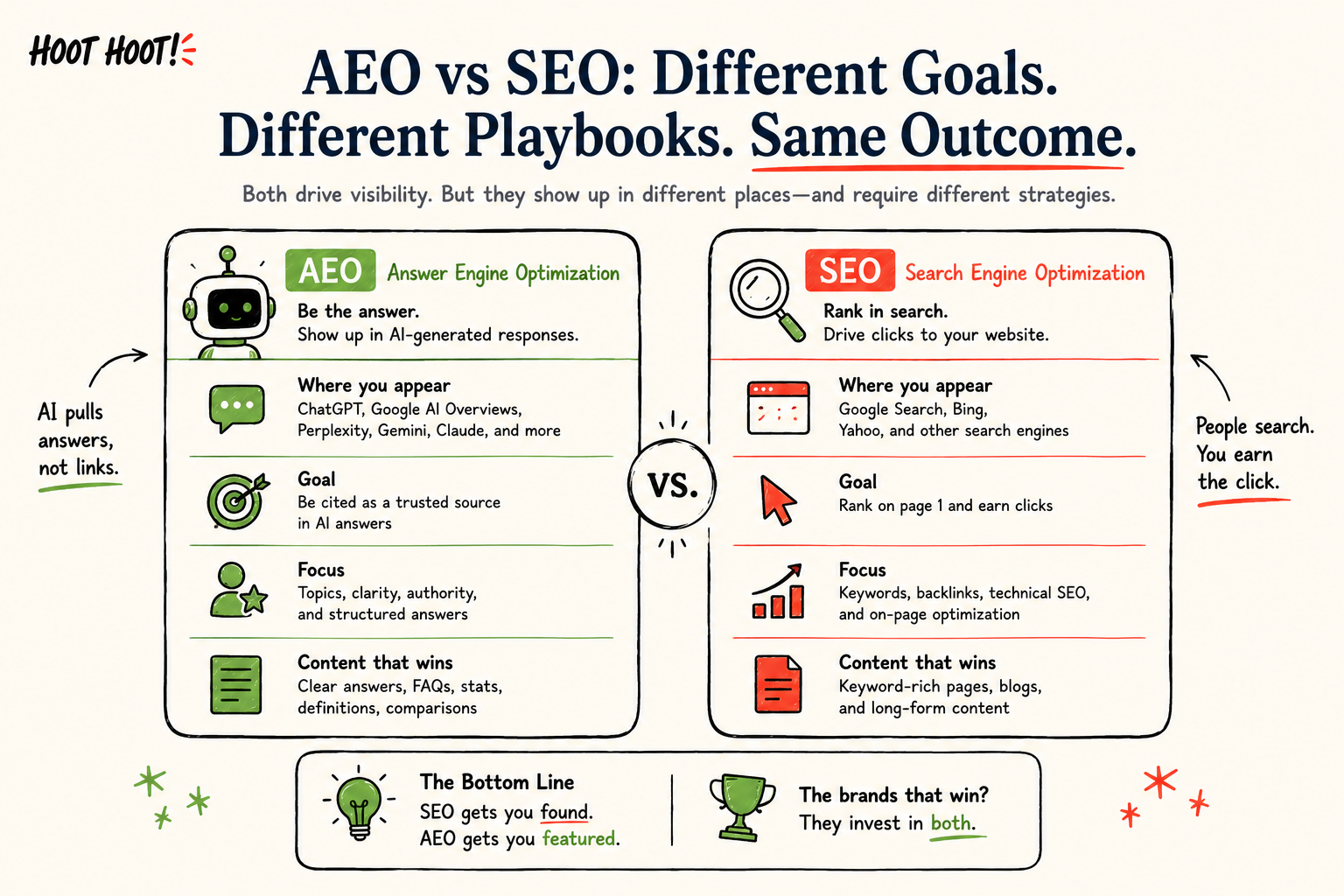

Search is changing from a list of blue links into a mix of search results, featured snippets, AI summaries, voice assistants, and answer engines. That shift does not make Search Engine Optimization (SEO) obsolete, but it does mean brands need to understand how Answer Engine Optimization (AEO) fits beside traditional search optimization.
In this article, you will learn how SEO vs AEO differs, where they overlap, and how to build content that is easier for both people and machines to understand.
What is the difference between AEO and SEO?
AEO focuses on making your content the clear, direct answer to a user’s question, while SEO focuses on improving visibility and rankings across search engine results. In simple terms, SEO helps people find your website, and AEO helps answer engines extract, trust, and present your answer when users ask for information.
Traditional SEO is still essential. It includes keyword research, technical performance, internal linking, content quality, backlinks, and user experience. AEO builds on those foundations but sharpens the goal: create content that can be quoted, summarized, or selected as the best response in featured snippets, AI-generated answers, voice search results, and conversational search experiences.
The difference is not that one replaces the other. The difference is that AEO is more answer-focused, entity-aware, and structured, while SEO is broader and often more traffic-focused.
Why SEO is still the foundation of AEO
SEO is the long-standing practice of helping search engines crawl, understand, rank, and display your content. When SEO works well, your pages are easier to index, more aligned with search intent, and more likely to attract qualified organic visitors. It remains one of the most reliable ways to build visibility over time.
Strong SEO usually includes:
- Keyword strategy: Choosing topics and phrases your audience actually searches for.
- Search intent alignment: Matching the page format and depth to what users want.
- Technical health: Improving crawlability, speed, mobile experience, and site structure.
- On-page optimization: Writing clear titles, headings, metadata, and body copy.
- Authority signals: Earning trust through helpful content, references, brand reputation, and links.
- Conversion paths: Guiding readers toward the next logical step after they land on the page.
The practical goal of SEO is not simply to rank. It is to bring the right audience to the right page at the right moment. Good search optimization connects visibility with usefulness, so users do not just click through; they stay, read, trust, and act.
What is AEO and how does it work?
AEO, or answer engine optimization, is the practice of formatting and writing content so answer engines can identify a specific, trustworthy response to a user’s question. It is especially relevant for search features that provide answers without requiring users to open multiple pages.
When people ask questions such as “What is AEO?” or “How is AEO different from SEO?”, answer engines look for content that is direct, structured, and credible. A page that buries the answer under long introductions or vague commentary may be less useful to an answer system, even if the underlying information is accurate.
AEO-friendly content often has a few recognizable traits:
- It answers a clear question early and plainly.
- It uses descriptive headings that match user intent.
- It defines important terms without jargon.
- It supports claims with context, examples, or evidence when available.
- It uses structured elements such as lists, steps, summaries, and concise explanations.
- It connects related entities, topics, and concepts in a way machines can interpret.
This is where aeo insights become valuable. Instead of only asking, “What keyword should we rank for?”, teams begin asking, “What exact question does the audience need answered, and what would make our answer the most useful one?”
Where do AEO and SEO overlap?
AEO and SEO are not separate silos. They share the same core principle: create useful, trustworthy content that matches user intent. If your website has weak technical SEO, thin content, confusing navigation, or poor credibility, AEO will be harder to achieve.
Both disciplines benefit from clear writing, fast-loading pages, logical information architecture, and helpful content. Both reward brands that understand their audience deeply. Both also depend on consistency; one optimized answer is not enough if the rest of the site sends mixed signals about expertise or relevance.
The main difference is emphasis. SEO often asks, “How can this page rank and attract organic traffic?” AEO asks, “How can this page provide the clearest answer that an engine can confidently use?” When combined, the result is content that can perform in classic search results and in answer-driven environments.
How do AEO strategies compare with traditional SEO effectiveness?
AEO strategies vs traditional SEO effectiveness should not be judged as a winner-takes-all contest. SEO is often more effective for building broad organic visibility, while AEO is especially effective for capturing question-based intent, earning answer placements, and making content usable in AI-driven search experiences.
A balanced approach is usually best. For example, a detailed blog post can use SEO to target a broader topic and AEO to answer specific questions within that topic. The page can rank for a primary keyword, appear for long-tail queries, and provide extractable answers for featured snippets or AI summaries.
A practical comparison looks like this:
- SEO priority: Drive qualified traffic from search results.
- AEO priority: Become the clearest answer to a specific query.
- SEO content style: Comprehensive, intent-matched, and internally connected.
- AEO content style: Direct, structured, concise where needed, and easy to summarize.
- SEO success signals: Rankings, impressions, clicks, engagement, and conversions.
- AEO success signals: Answer visibility, snippet presence, brand mentions, assisted discovery, and qualified follow-up actions.
The takeaway is simple: SEO brings the audience closer to your site, while AEO helps your expertise travel into the answer layer of search.
What are the benefits of AEO for my brand?
Paragraph: The strongest AEO benefits come from meeting users where they now search. People increasingly ask full questions, use voice interfaces, skim AI summaries, and expect immediate clarity. Brands that write in a direct, structured way are better prepared for this behavior.
AEO can help your content become more useful in several ways:
- Clearer communication AEO forces content to answer the user’s real question quickly. That improves readability for humans, not just machines.
- Stronger topical authority When your content consistently explains related questions, definitions, and processes, it builds a more complete knowledge footprint around your subject.
- Better support for conversational search Users do not always search in short keywords anymore. AEO helps you respond to natural-language questions that sound like real conversations.
- Improved content planning AEO encourages teams to organize content around questions, tasks, and decisions. That often leads to more useful blog posts, service pages, and guides.
- More resilient visibility Search results continue to evolve. Content that is well structured, trustworthy, and answer-ready is more adaptable across traditional and emerging formats.
AEO does not guarantee placement in every answer engine. No ethical strategy can promise that. But it does improve the quality, clarity, and usability of your content, which are valuable outcomes regardless of the search format.
How do I combine my AEO and SEO strategies?
The smartest approach is to treat AEO as an extension of SEO, not a replacement. Start with the fundamentals of search optimization, then refine each page so it answers specific questions clearly.
Use this workflow when creating or updating content:
- Identify the main search intent Decide whether the user wants a definition, comparison, process, recommendation, product information, or deeper education.
- Map the questions behind the keyword A keyword like “seo vs aeo” may include several questions: What do they mean? Which one matters more? How do they work together? What should a business do first?
- Answer the primary question near the top Do not make readers hunt for the answer. A concise opening answer helps users and answer engines understand the page immediately.
- Use headings that reveal the structure Headings should guide the reader through the topic. A few question headings are useful, but most headings should state the section’s focus clearly.
- Add structured explanations Use bullet points, numbered steps, examples, and short definitions to make the content easier to scan and extract.
- Strengthen credibility Avoid unsupported claims. Where possible, add examples, expert context, product knowledge, customer pain points, or reputable sources.
- Connect the next step Once the reader understands the topic, guide them toward a practical action, whether that is reading another resource, auditing content, or booking a strategy session.
Common mistakes to avoid with AEO and SEO
Many teams overcorrect when they first learn about AEO. They create pages that feel like a list of disconnected answers, or they reduce useful content to short definitions with no depth. That can make the page less helpful, not more.
Avoid these mistakes:
- Writing only for machines: Answer engines matter, but people still need context, clarity, and confidence.
- Ignoring SEO fundamentals: A page that cannot be crawled, indexed, or trusted will struggle in both SEO and AEO.
- Stuffing question keywords: Natural language is better than repeating the same phrase unnaturally.
- Using vague answers: AEO rewards specificity, but only when it is accurate and supported.
- Forgetting conversion intent: Visibility is useful only if the page helps the reader take the next step.
The best content feels natural to readers and structured to systems. It answers quickly, explains clearly, and then gives enough detail to support a decision.
The takeaway for growing search visibility
AEO and SEO work best together. SEO gives your content the technical, strategic, and authority foundation it needs to be discovered. AEO makes that content more answer-ready, especially for AI summaries, featured snippets, voice search, and conversational search behavior.
If you are deciding where to start, do not abandon your SEO strategy. Improve it by adding sharper answers, clearer headings, structured explanations, and content that reflects how people ask questions today. That is the practical path from ranking for keywords to becoming a trusted source of answers.
Ready to make your content easier to find, understand, and act on? Book a strategy conversation with HootHoot and start building a smarter approach to SEO and AEO together.
About the Author
Jaymin Shah is the co-founder of HootHoot, an Answer Engine Optimization (AEO) agency helping brands improve their visibility across Ai-powered search and answer engines. He has 10+ years experience specializing in SEO, AEO, and content strategy with a focus on understanding how brands can earn greater visibility and citations as search shifts from traditional results to AI-generated answers.