
Essential AI Search Optimization: Beginner Techniques

What Are Essential AI Search Optimization Techniques For Beginners?
AI search optimization is the process of making your website easier for AI-powered search systems to understand, trust, retrieve, and cite. The most important techniques include improving crawlability, answering questions directly, structuring content clearly, building topical authority, earning credible third-party mentions, using appropriate structured data, and measuring your visibility across AI search platforms.
For beginners, the smartest approach is not to chase obscure AI hacks. It is to strengthen the foundations that already make content useful and discoverable while adapting them to a search environment where an AI system may answer the question before someone ever clicks a traditional search result.
If you are completely new to the concept, our guide to Answer Engine Optimization explains how AEO works and why it is becoming an increasingly important part of search visibility.
What are the most important AI search optimization techniques?
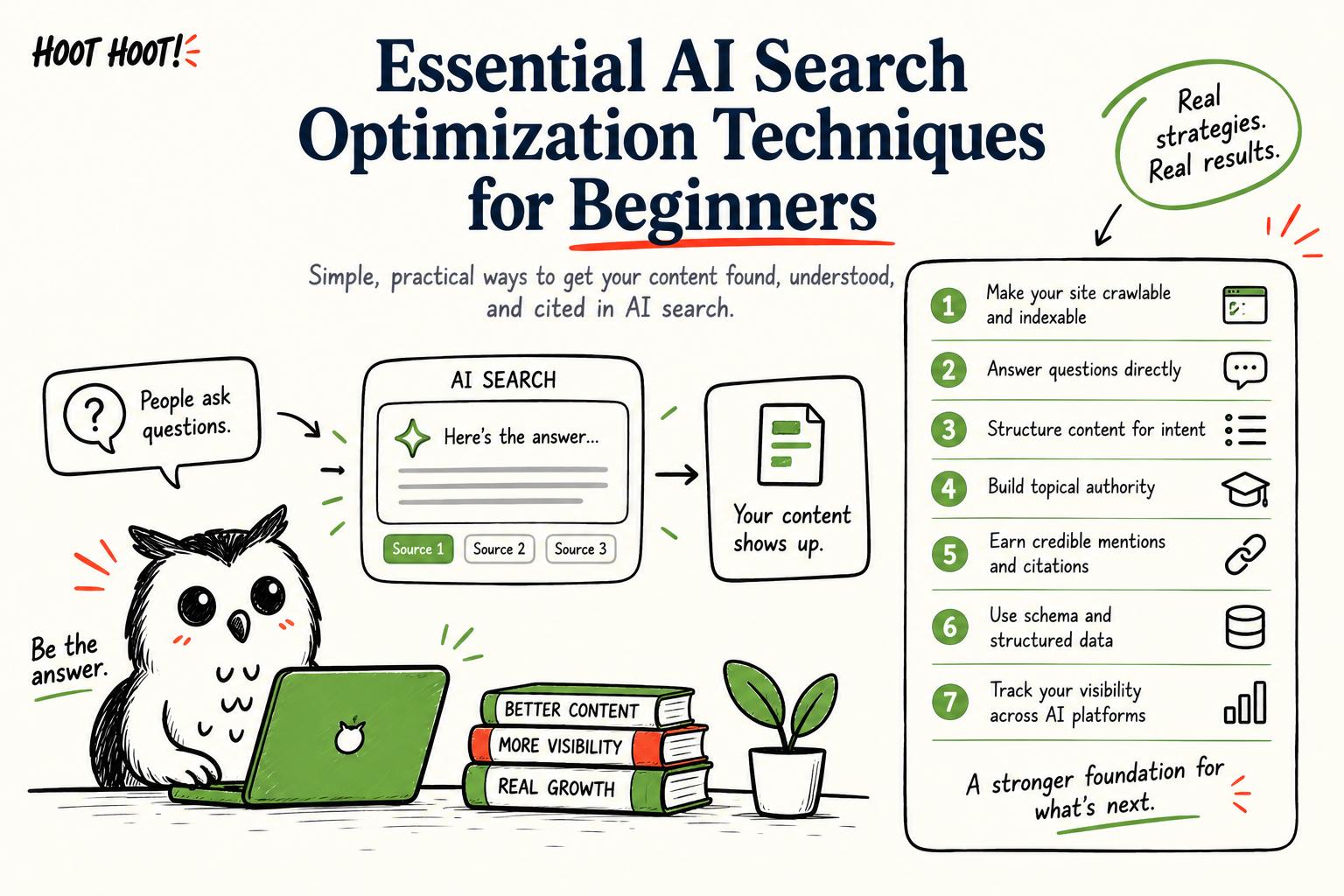
The seven essential AI search optimization techniques for beginners are:
- Make your website crawlable and indexable.
- Answer important questions directly.
- Structure content around specific search intent.
- Build topical authority around your core expertise.
- Earn credible third-party mentions and citations.
- Use schema and structured data where appropriate.
- Track your visibility across AI search platforms.
These techniques share an important theme: make it as easy as possible for search systems to find your information, understand what it means, determine whether it is trustworthy, and retrieve the right passage when answering a user's question.
What changes when AI search answers the question?
AI search changes the user experience by synthesizing answers instead of merely ranking links. That means your content needs to be both rankable and extractable: a crawler should be able to access it, an algorithm should be able to interpret it, and a human reader should immediately recognize its usefulness.
Traditional search often rewarded pages that matched a query, earned links, and satisfied search intent. AI-mediated search adds another layer. A search engine may assemble an answer using several sources, mention a brand without sending the user directly to its website, or retrieve one particularly useful passage from a much larger page.
Microsoft, for example, describes generative search as a system that interprets a query, reviews sources, dynamically matches content, and produces an AI-generated response designed around the user's intent.
That does not make SEO obsolete. It makes clarity, entity recognition, topical authority, and reputation more consequential.
A conventional blog post might bury its answer after a long introduction. A page optimized for AI discovery should still be engaging, but it should answer the central question near the top, use descriptive headings, define ambiguous terminology, and support important claims with evidence or first-hand expertise.
The objective is not to write for machines instead of people. The objective is to write clearly enough that machines can accurately represent your information to people.
How do you make your website accessible to AI search engines?
Before refining your content or experimenting with AI SEO tools, make sure your site can actually be crawled, rendered, and understood.
AI search systems cannot reliably retrieve pages they cannot discover or access. Technical SEO therefore remains an important foundation for AI search optimization.
Start with the basics. Your important pages should return clean status codes, work properly on mobile devices, load quickly enough to be usable, and include meaningful HTML elements such as title tags, meta descriptions, headings, canonical tags, internal links, and descriptive alt text.
A simple beginner audit should include:
- Check indexability. Make sure priority pages are not blocked by robots directives, noindex tags, login walls, or accidental canonicalization.
- Improve internal linking. Link related guides, service pages, case studies, and comparison pages using descriptive anchor text.
- Simplify page structure. Use one logical H1, organized H2s and H3s, and paragraphs that remain understandable when read independently.
- Repair thin or duplicate pages. Consolidate overlapping content so search systems encounter a stronger, more authoritative resource.
- Add descriptive media context. Images and videos should include appropriate file names, captions where useful, transcripts for video or audio, and descriptive alt text.
- Monitor crawl errors. Use search platform diagnostics and site audit tools to identify broken links, redirect chains, and pages that unexpectedly disappear from search.
- Maintain an accurate sitemap. Help search engines discover your important URLs and understand when content has genuinely changed.
Microsoft specifically recommends maintaining accurate XML sitemaps and lastmod values to help Bing discover current content for both traditional and AI-powered search experiences.
These steps are not glamorous, but beginners often see the clearest gains by removing obstacles before adding complexity. If a search system struggles to access or parse your content, advanced optimization becomes much less useful.
How should you structure content for AI search?
Content for AI search should make important answers explicit rather than forcing a system to infer them from a long page.
A strong page usually opens with a concise answer and then develops the subject with context, examples, evidence, and nuance.
For instance, if you sell project management software, an article might define the category, explain who needs it, compare common use cases, address implementation concerns, and explain how someone should make a buying decision. Each section resolves a distinct question.
Practical formatting can make information easier for both AI systems and human readers to understand:
- Put the direct answer to an important question within the first few sentences of the relevant section.
- Use descriptive headings that reflect natural search intent.
- Define acronyms and specialized terms before relying on them.
- Use short lists for steps, criteria, risks, and examples.
- Include concise summaries when a section covers several ideas.
- Avoid unsupported claims such as "best," "leading," or "most trusted."
- Keep introductions purposeful instead of delaying the answer unnecessarily.
- Make important paragraphs understandable even when viewed without the rest of the article.
The more precise your information architecture is, the easier it becomes for a search system to retrieve the right information and for a reader to trust the page once they arrive.
What is the difference between SEO and AI search optimization?
SEO primarily helps pages become discoverable and competitive in traditional search results. AI search optimization builds on those principles while placing additional emphasis on making content easy to retrieve, understand, summarize, and cite within AI-generated answers.
Traditional SEO is therefore not something you replace when adopting AEO. It is the foundation you build upon.
For a deeper breakdown of where the two strategies overlap and where they differ, read our complete guide to AEO vs. SEO.
The practical difference is emphasis. SEO asks, "How can this page rank for this search?"
AI search optimization adds another question: "How can this information become a trusted source for the answer?"
How do you build topical authority for AI search?
Topical authority comes from demonstrating meaningful expertise across a subject rather than publishing isolated articles targeting unrelated keywords.
Instead of treating every keyword as an independent content opportunity, identify the subjects your company genuinely knows and build connected resources around them.
For example, a cybersecurity consultancy might create in-depth resources covering:
- Risk assessments
- Incident response
- Vendor due diligence
- Employee security training
- Compliance preparation
- Security policies
- Common vulnerabilities
Internal links can then establish relationships between those resources and help both readers and search systems understand the broader area of expertise.
This approach also makes individual articles more useful. Rather than attempting to explain an entire industry in one enormous page, you can answer specific questions thoroughly while connecting readers to deeper resources where appropriate.
How do you build authority outside your own website?
A website can claim expertise, but authority becomes much stronger when other credible sources corroborate it.
That makes off-site reputation particularly important for AI search optimization.
If your brand appears in respected directories, relevant podcasts, conference pages, partner ecosystems, industry publications, review platforms, research, or substantive community discussions, those references create additional context about who you are and what you are known for.
Useful off-site credibility tactics include:
- Contributing expert commentary to reputable industry publications.
- Encouraging satisfied customers to leave honest reviews on appropriate platforms.
- Maintaining accurate business profiles and directory listings.
- Publishing original research, benchmarks, templates, or frameworks that others may cite.
- Participating in relevant communities with substantive answers rather than promotional comments.
- Building partnerships that create natural co-mentions, interviews, webinars, or resource pages.
The key is legitimacy.
Posting low-quality comments, manufacturing reviews, or distributing identical promotional blurbs across weak websites does not create meaningful authority. A better rule is to pursue off-site activity that would still be worthwhile if search engines did not exist.
In an AI search environment, what credible sources say about your company can become just as important as what your company says about itself.
Does schema markup help with AI search optimization?
Schema markup can help search systems understand what a page and its individual elements represent, but schema alone does not guarantee inclusion in an AI-generated answer.
Schema.org provides a shared structured-data vocabulary that can describe entities, relationships, products, organizations, articles, people, events, videos, and many other types of information.
For beginners, the priority should be to use structured data honestly where it matches the actual content of the page.
Depending on the page, that could include markup related to:
- Organization
- Person
- Article
- Product
- Breadcrumbs
- Video
- Reviews
- Other applicable content types
Structured data should clarify information that genuinely exists on the page. It should not be treated as a way to tell search engines something that the visible content itself does not support.
Examples can also make meaning easier to extract.
Instead of simply telling a reader to "write clear headings," show a weak heading and a stronger alternative. Instead of telling a business to "build topical authority," demonstrate what a useful topic cluster might actually look like.
Concrete examples remove ambiguity for readers and create more specific information for search systems to interpret.
Which AI SEO hacks should beginners avoid?
Beginners should avoid tactics that promise AI visibility without improving accessibility, usefulness, authority, accuracy, or user experience.
Be cautious when someone claims that a single file, tag, prompt, or formatting trick will suddenly make AI systems prefer your website.
Some emerging conventions may eventually become useful. But beginners should not reallocate significant resources away from established fundamentals until a tactic has clear evidence, platform support, and practical relevance.
A better mindset is:
- Instead of chasing secret prompts, answer real customer questions clearly.
- Instead of mass-producing generic AI content, publish differentiated expertise, examples, and decision support.
- Instead of obsessing over one emerging file format, maintain crawlability, structured HTML, and accurate sitemaps.
- Instead of buying questionable mentions, earn credible references through useful work.
- Instead of measuring only traffic, track visibility, citations, leads, conversions, and branded demand.
The durable advantage is not tricking a model. It is becoming a source that deserves to be retrieved.
How do you measure AI search visibility?
AI search optimization is still evolving, so measurement should be built into your strategy from the beginning.
Traditional metrics such as rankings, impressions, organic traffic, and conversions still matter. However, brands should increasingly look at whether they appear inside AI-generated answers and how frequently their content is referenced.
Useful AI visibility metrics can include:
- AI citations
- Brand mentions
- Cited pages
- Queries that trigger citations
- Share of voice compared with competitors
- Branded search demand
- Referral traffic from AI platforms
- Leads and conversions influenced by AI discovery
For many beginners, a simple monthly routine is enough: review your most important pages, inspect relevant queries, check how your brand and competitors appear across major AI search experiences, document where your company is cited or absent, and improve pages that no longer provide the strongest answer.
Over time, that creates a feedback loop between visibility, content quality, authority, and business outcomes.
Frequently asked questions about AI search optimization
What is AI search optimization?
AI search optimization is the process of making online content easier for AI-powered search systems to discover, understand, retrieve, summarize, and cite. It builds on traditional SEO while placing greater emphasis on direct answers, structured information, authority, and visibility within generated responses.
Is AI search optimization the same as SEO?
No. AI search optimization builds on traditional SEO rather than replacing it. SEO focuses heavily on search rankings, impressions, clicks, and organic traffic, while AI search optimization also considers whether a brand or its content appears as a source within AI-generated answers.
If you want to understand this distinction in more detail, see our AEO vs. SEO comparison.
How do you optimize content for AI search?
Start by making your pages crawlable, answering important questions directly, using descriptive headings, building topical authority, demonstrating first-hand expertise, earning credible third-party mentions, using appropriate structured data, and monitoring AI citations and mentions.
Does schema help with AI search?
Schema can provide structured information about the entities and content on a webpage, making their meaning less ambiguous to systems that support that structured data. However, adding schema does not guarantee that a page will appear or be cited in an AI-generated answer.
How long does AI search optimization take?
There is no universal timeline for AI search optimization. Results depend on factors such as crawlability, competition, existing domain authority, content quality, third-party reputation, and how frequently search systems discover and reassess your content. AEO should be treated as an ongoing optimization process rather than a one-time change.
The practical takeaway
Essential AI search optimization is not a separate discipline built on secret maneuvers. It is an extension of good SEO and good publishing: make your site accessible, answer questions clearly, structure information so it can be understood independently, demonstrate authority on and off your domain, use structured data responsibly, and measure how your visibility changes across both traditional and AI-mediated search.
For beginners, the best next step is to choose one important topic and improve it systematically. Audit the page technically, rewrite the opening answer for clarity, strengthen supporting sections, add appropriate schema, improve internal linking, support important claims with credible sources, and identify places across the web where your brand should legitimately be mentioned.
AI search will continue to evolve, but the fundamental objective is unlikely to change: become the source that provides the clearest, most useful, and most credible answer.
For more guidance on improving your visibility across AI search, visit HootHoot.
About the Author
Jaymin Shah is the co-founder of HootHoot, an Answer Engine Optimization (AEO) agency helping brands improve their visibility across Ai-powered search and answer engines. He has 10+ years experience specializing in SEO, AEO, and content strategy with a focus on understanding how brands can earn greater visibility and citations as search shifts from traditional results to AI-generated answers.